

Technical Contents
Engineering Guide: Lsr Silicone Molding
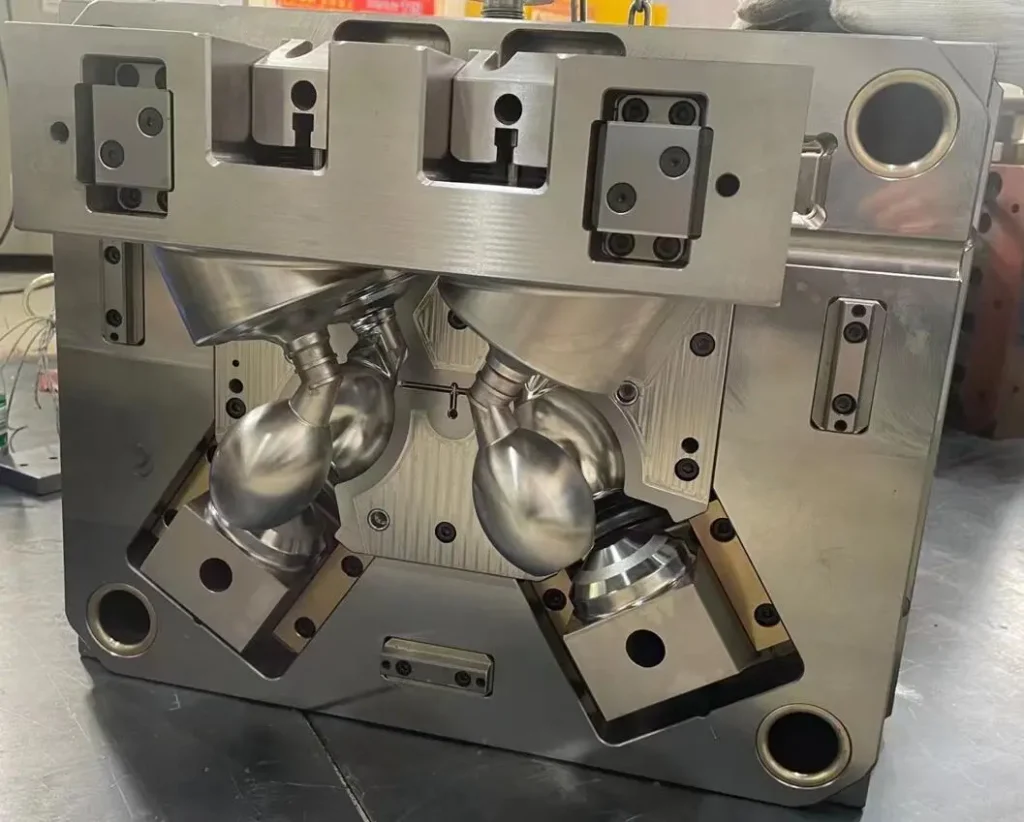
Engineering Insight: Precision in LSR Silicone Molding
Liquid Silicone Rubber (LSR) molding is a critical process in high-performance manufacturing, especially within industries where reliability, durability, and exacting tolerances are non-negotiable. At Wuxi Lead Precision Machinery, we understand that the success of LSR molding hinges on precision at every stage—from mold design and material handling to injection control and post-cure finishing. As a leader in custom metal manufacturing, our expertise extends beyond metal components into the integration of advanced elastomeric systems, ensuring seamless performance in complex assemblies.
LSR is renowned for its thermal stability, chemical resistance, and biocompatibility, making it ideal for applications in medical devices, automotive sensors, aerospace systems, and high-end consumer electronics. However, these benefits can only be fully realized when the molding process maintains micron-level accuracy. Even minor deviations in wall thickness, gate placement, or curing temperature can result in part failure, especially in miniaturized or safety-critical components.
Precision begins with mold fabrication. At Wuxi Lead, our molds are engineered using high-grade tool steels and manufactured on CNC platforms with sub-micron repeatability. We employ 3D modeling and mold flow simulation to anticipate material behavior, minimizing flash, knit lines, and internal stresses. Our in-house metrology lab ensures that every cavity and core meets ISO 2768 or customer-specific tolerances before production launch.
Our experience in mission-critical manufacturing has been validated through projects supporting Olympic-grade equipment and military-grade electronics. These applications demand not only flawless part consistency but also full traceability, cleanroom compatibility, and adherence to MIL-STD and ISO 13485 standards. Our LSR molding cells operate in controlled environments with closed-loop monitoring of injection pressure, temperature profiles, and cycle times—ensuring batch-to-batch uniformity.
Material handling is another pillar of precision. LSR components are sensitive to moisture and contamination. Our automated dispensing systems maintain accurate A:B ratios, while dehumidified storage and vacuum degassing eliminate microbubbles that could compromise structural integrity. This level of control is essential when producing seals, gaskets, or diaphragms for life-support systems or defense hardware.
Wuxi Lead’s integration of custom metal fabrication with advanced LSR molding enables hybrid solutions—such as overmolded metal inserts with hermetic seals—where metal and silicone function as a single engineered unit. This synergy is where precision meets performance.
| Specification | Detail |
|---|---|
| Typical Tolerance Range | ±0.02 mm |
| Mold Material | H13, S136, 420 Stainless Steel |
| Clamping Force Range | 50–1,200 Tons |
| Process Control | Closed-loop injection, real-time monitoring |
| Cleanroom Compliance | ISO Class 7 (10,000) and above |
| Standards Supported | ISO 9001, ISO 13485, MIL-STD-883 |
Our commitment to precision in LSR silicone molding is not just technical—it’s a philosophy rooted in the demands of the most challenging industrial environments. With every component we produce, we deliver engineered reliability.
Precision Specs & Tolerances
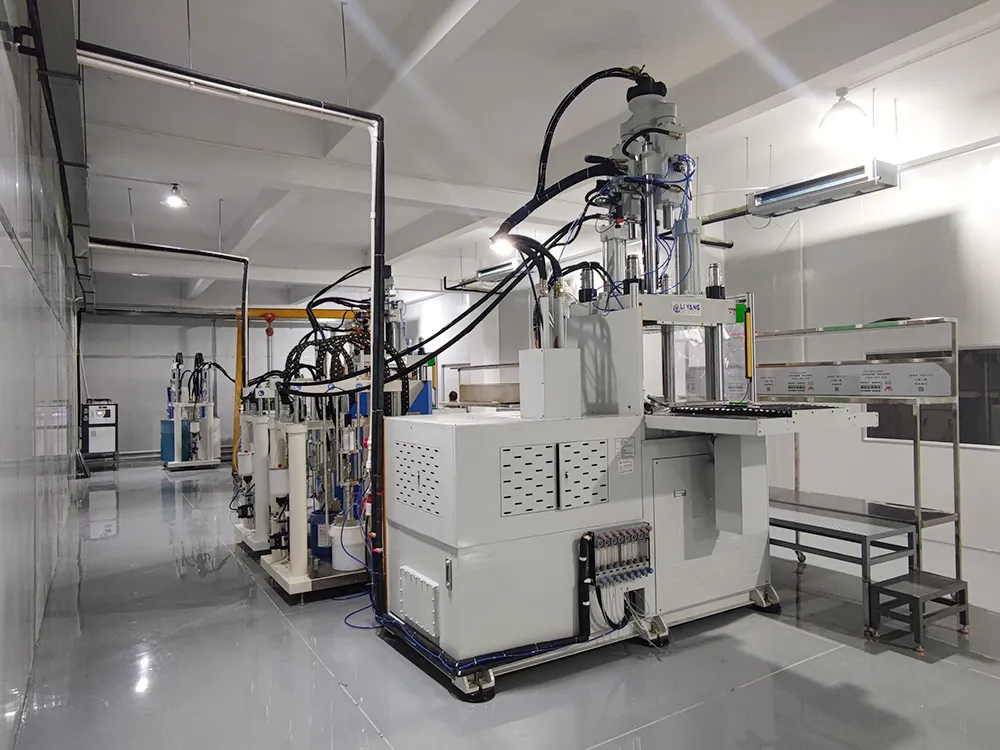
Technical Capabilities: Precision Metal Components for LSR Silicone Molding Excellence
Wuxi Lead Precision Machinery delivers the foundational metal precision essential for high-performance Liquid Silicone Rubber (LSR) molding success. Our core competency lies in manufacturing the complex, ultra-precise mold bases, cavities, cores, and critical ancillary components that directly determine the dimensional accuracy, surface quality, and longevity of LSR production molds. We understand that LSR molding demands exceptional thermal stability, micron-level tolerances, and flawless surface finishes on the metal tooling to replicate intricate part geometries consistently and prevent flash or parting line issues. Our integrated manufacturing and quality control processes are engineered specifically to meet these rigorous demands.
Central to our capability is advanced 5-axis CNC machining. Utilizing state-of-the-art multi-axis centers, we achieve complex geometries and tight tolerances in a single setup, eliminating cumulative errors inherent in multi-operation processes. This simultaneous 5-axis capability is critical for machining the deep, under-cut cavities, intricate cooling channels, and precisely angled shut-off surfaces common in high-cavitation LSR molds. Our machining centers feature high rigidity, thermal compensation systems, and sub-micron positioning accuracy, ensuring the dimensional integrity and surface integrity required for zero-defect LSR part production. Material selection expertise spans premium mold steels like H13, S136, and specialized alloys, optimized for thermal conductivity, wear resistance, and compatibility with aggressive LSR compounds.
Rigorous quality control is non-negotiable. Every critical dimension and feature undergoes comprehensive verification using calibrated Coordinate Measuring Machines (CMM). Our Zeiss and Hexagon CMM systems perform full 3D scanning and point-cloud analysis, providing detailed deviation reports against the original CAD model. This metrology-driven approach validates geometric dimensioning and tolerancing (GD&T), critical for ensuring perfect mold alignment, core pin fit, and cavity/core matching – factors paramount to eliminating flash and achieving consistent part dimensions in LSR molding. Surface finish is meticulously measured using profilometers to guarantee the required Ra values for optimal part release and surface aesthetics.
The following table details our standard achievable capabilities for LSR mold components, reflecting the precision inherent in our process:
| Feature Category | Capability | Typical Tolerance/Value | Measurement Standard |
|---|---|---|---|
| Linear Dimensions | General Machining | ±0.005 mm | ISO 2768-mk |
| Critical Mold Features | ±0.002 mm | ISO 2768-fk | |
| Geometric Tolerances | Position (Critical Pins/Cavities) | Ø 0.003 mm | ASME Y14.5 GD&T |
| Flatness (Parting Surfaces) | 0.001 mm / 100 mm | ASME Y14.5 GD&T | |
| Parallelism/Perpendicularity | 0.002 mm | ASME Y14.5 GD&T | |
| Surface Finish (Ra) | Cavity/Core Surfaces | 0.05 – 0.20 µm | ISO 4287 |
| General Mold Components | 0.4 – 0.8 µm | ISO 4287 | |
| Material Hardness | Pre-hardened Tool Steels | HRC 48-52 (as specified) | ASTM E18 |
| Through-hardened Steels | HRC 50-54 (as specified) | ASTM E18 |
This commitment to precision engineering, backed by advanced 5-axis CNC technology and uncompromising CMM-based quality assurance, ensures Wuxi Lead Precision Machinery provides the reliable, high-performance metal foundation your LSR molding operations require for consistent, high-yield production of critical silicone components.
Material & Finish Options
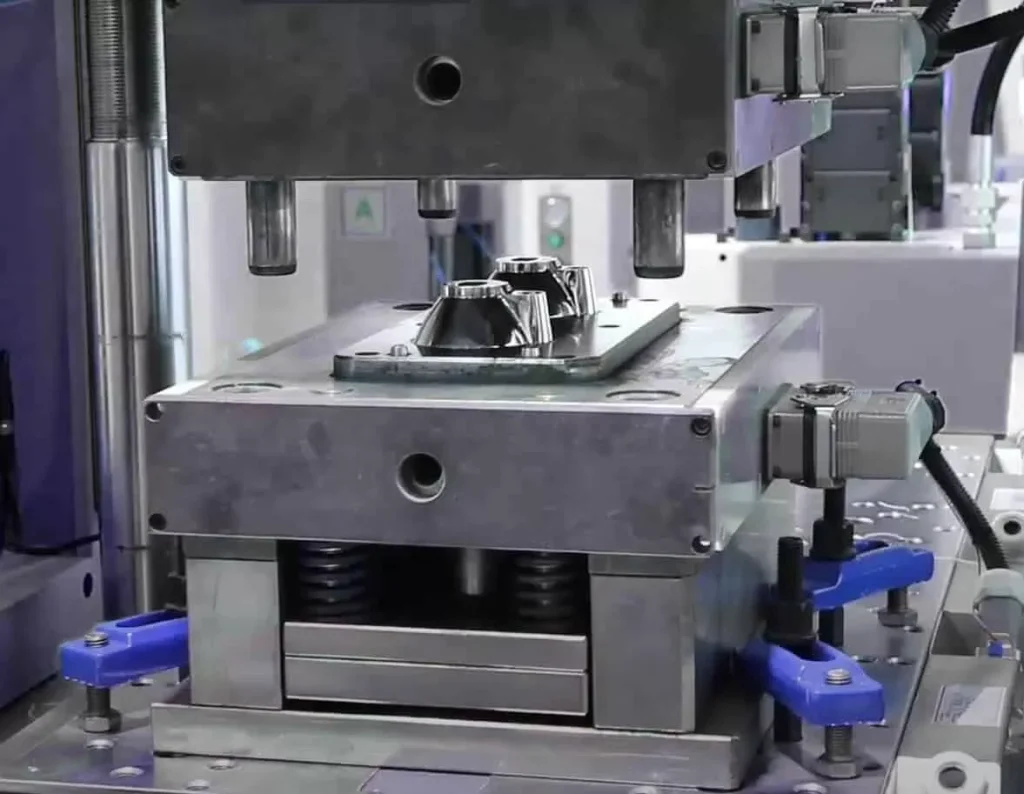
Material selection plays a critical role in the performance, durability, and cost-efficiency of components used in liquid silicone rubber (LSR) molding processes. At Wuxi Lead Precision Machinery, we specialize in custom metal manufacturing solutions tailored to high-precision molding applications. Understanding the mechanical and thermal properties of materials such as aluminum, steel, and titanium—along with appropriate surface treatments like anodizing—is essential for optimizing tool life, part quality, and production efficiency.
Aluminum is widely used in LSR molding due to its excellent thermal conductivity and lightweight nature. It allows for rapid heat transfer, which supports faster cycle times and improved productivity. Its machinability also reduces lead time and tooling costs, making aluminum ideal for prototyping and medium-volume production. However, aluminum has lower wear resistance compared to steel and titanium, limiting its use in high-volume or abrasive applications.
Steel, particularly tool steel grades such as H13 or P20, offers superior hardness, wear resistance, and dimensional stability under prolonged thermal cycling. These properties make steel the preferred choice for high-volume LSR molding operations where long tool life and consistent part quality are paramount. While steel molds have higher initial costs and longer machining times, their durability often results in lower total cost of ownership over extended production runs.
Titanium is less commonly used but provides exceptional strength-to-density ratio and corrosion resistance. It maintains structural integrity at elevated temperatures and is highly resistant to thermal fatigue. Although titanium is more expensive and challenging to machine, it is suitable for specialized applications requiring extreme performance under aggressive processing conditions or where weight reduction is critical.
Surface finishing, particularly anodizing, significantly enhances the functional properties of aluminum molds. Anodizing creates a hard, wear-resistant oxide layer that improves surface hardness, reduces friction, and increases resistance to corrosion and galling. Type II (sulfuric acid) and Type III (hardcoat) anodizing are commonly applied, with Type III offering superior thickness and durability for demanding molding environments. While anodizing is specific to aluminum, steel and titanium benefit from alternative treatments such as nitriding, polishing, or PVD coatings to achieve similar performance gains.
The following table summarizes key material properties and applications in LSR molding:
| Material | Thermal Conductivity (W/m·K) | Hardness (HRC) | Typical Use Case | Surface Treatment Options |
|---|---|---|---|---|
| Aluminum (7075) | 130 | 40–50 | Prototyping, low-to-medium volume | Anodizing (Type II/III), Alodine |
| Steel (H13) | 30–35 | 48–52 | High-volume production, inserts | Nitriding, polishing, PVD coating |
| Titanium (Grade 5) | 7.2 | 35–40 (after treatment) | Specialized, high-temp applications | Anodizing, nitriding, oxidation |
Selecting the right material and finish requires balancing performance requirements, production volume, and cost. Wuxi Lead Precision Machinery provides expert consultation and precision manufacturing to ensure optimal material integration for your LSR molding needs.
Manufacturing Process & QC
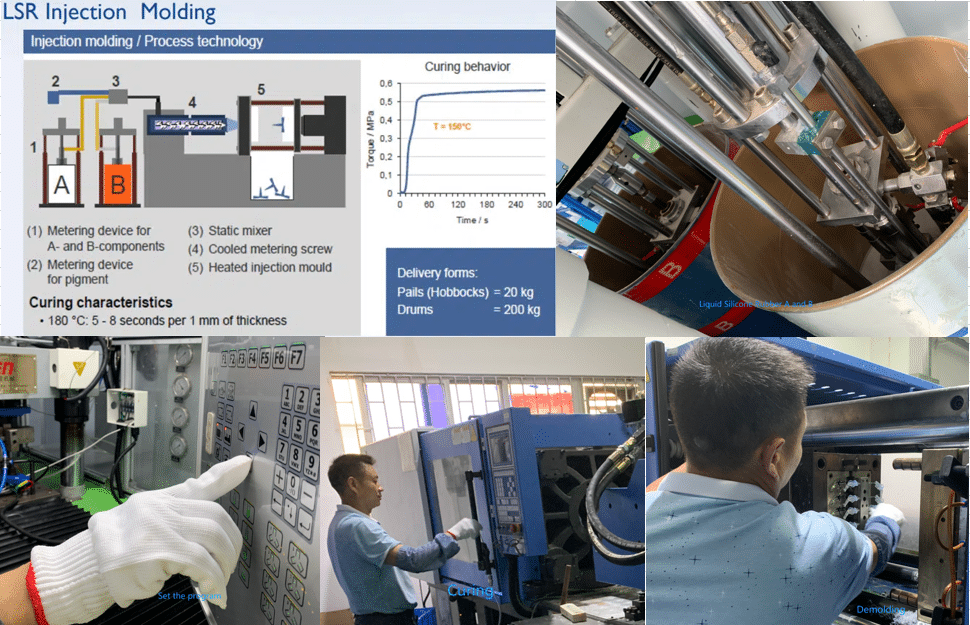
LSR Silicone Molding: Precision Execution from Concept to Zero-Defect Production
At Wuxi Lead Precision Machinery, our Liquid Silicone Rubber (LSR) molding process is engineered for uncompromising quality in demanding medical, automotive, and consumer applications. We execute a rigorously controlled sequence: Design Validation, Precision Prototyping, and Zero-Defect Mass Production. This integrated approach ensures your complex silicone components meet exacting performance and regulatory requirements from inception to high-volume fulfillment.
The foundation is meticulous Design Validation. Our engineering team collaborates closely with clients using advanced CAD/CAE tools to simulate material flow, predict potential weld lines, optimize gate placement, and validate thermal management. This phase critically assesses part geometry against LSR’s unique properties – viscosity, cure kinetics, and thermal expansion – ensuring moldability and functional integrity. Material selection adheres strictly to biocompatibility standards (ISO 10993) or automotive specifications, with full traceability. Design for Manufacturability (DFM) reviews identify and resolve potential defects like flash or incomplete fills before tooling begins, preventing costly iterations later.
Precision Prototyping transforms validated designs into tangible, functional samples. Utilizing high-precision CNC-machined prototype molds, we produce 5-10 initial parts under controlled production-like conditions. These samples undergo comprehensive metrology using Coordinate Measuring Machines (CMM) and optical comparators, verifying critical dimensions against the CAD model within micron tolerances. Functional testing, including durometer checks, tensile strength validation, and application-specific performance assessments, confirms material behavior and part functionality. Client feedback on these prototypes is incorporated immediately, refining the design and process parameters to achieve perfect form, fit, and function prior to full-scale commitment.
Zero-Defect Mass Production leverages our validated process within a tightly controlled environment. Production occurs in ISO Class 10,000 cleanrooms using state-of-the-art, servo-driven LSR injection molding presses with closed-loop control. Real-time cavity pressure monitoring and multi-zone temperature control ensure consistent material flow and cure. Every production run implements Statistical Process Control (SPC), continuously tracking key parameters like shot weight, cure time, and clamp force. Crucially, 100% automated vision inspection systems scrutinize every part for surface defects, flash, or dimensional deviations against the approved prototype. Only components passing all stringent checks are released, with full traceability from raw material lot to finished part. Our integrated Quality Management System (ISO 13485 certified) ensures continuous monitoring and immediate corrective action, guaranteeing sustained zero-defect output.
Critical LSR Production Specifications at Wuxi Lead Precision Machinery
| Parameter | Capability | Control Method |
|---|---|---|
| Dimensional Tolerance | ±0.005 mm (critical features) | CMM, Optical Comparator, SPC |
| Shot Weight Consistency | ±0.1 g | In-line Weighing, Closed-Loop SPC |
| Surface Defect Detection | 100% Automated Vision | High-Resolution Cameras, AI Algorithms |
| Material Certification | USP Class VI, ISO 10993, FDA CFR 21 | Full CoA, Traceable Lot Numbers |
| Cleanroom Environment | ISO Class 10,000 | Continuous Particle Monitoring |
Why Choose Wuxi Lead Precision
Partner with Lead Precision for Advanced LSR Silicone Molding Solutions
At Wuxi Lead Precision Machinery, we specialize in delivering high-precision, custom metal manufacturing solutions tailored to the exacting demands of the LSR (Liquid Silicone Rubber) molding industry. As a trusted partner to global manufacturers, we combine decades of engineering expertise with cutting-edge CNC fabrication to produce molds and components that ensure repeatability, durability, and superior performance in high-volume production environments.
Our focus on LSR molding systems positions us at the forefront of innovation in medical, automotive, and consumer electronics manufacturing. We understand that success in these industries hinges on tight tolerances, contamination control, and long mold life—requirements we meet with rigorous quality standards and advanced material selection. From initial concept and design validation to final production and ongoing technical support, our team works closely with clients to deliver fully optimized solutions.
What sets Wuxi Lead apart is our integrated approach to custom manufacturing. We design and build all core components in-house, including mold bases, cavity and core inserts, feed systems, and ejection mechanisms—all machined to micron-level accuracy. Our engineers utilize state-of-the-art 3D modeling and simulation tools to optimize flow dynamics and thermal distribution, ensuring consistent part quality and reduced cycle times.
We serve clients across Europe, North America, and Asia, supporting both prototype development and full-scale production runs. Whether you require a single precision mold or a complete turnkey system, our agile manufacturing model allows rapid iteration and fast time-to-market—without compromising on quality.
Below are key technical specifications that define our LSR molding capabilities:
| Specification | Detail |
|---|---|
| Maximum Mold Size | 1200 mm × 800 mm × 700 mm |
| Minimum Tolerance | ±0.002 mm |
| Surface Finish | Ra 0.05 µm (mirror polish available) |
| Materials Used | H13, S136, 420SS, 17-4PH, and custom alloys |
| CNC Equipment | 5-axis machining centers, wire EDM, grinding |
| Lead Time (Standard Mold) | 25–35 days from design approval |
| Quality Standards | ISO 9001:2015 certified, full traceability |
| Applications | Medical devices, infant care products, automotive seals, wearables |
Every project we undertake is backed by a commitment to transparency, technical excellence, and long-term partnership. We don’t just manufacture molds—we engineer performance.
For manufacturers seeking a reliable, technically advanced partner in LSR silicone molding, Wuxi Lead Precision Machinery offers the precision, scalability, and engineering depth needed to stay ahead in competitive markets. Contact us today to discuss your next project. Email us at [email protected] and let our team provide a customized solution that meets your production goals.
⚙️ Precision Cost Estimator
Estimate relative manufacturing effort based on tolerance.