Technical Contents
Engineering Guide: Steel Sheet Bending Machine

Engineering Insight Precision in Steel Sheet Bending
Precision in steel sheet bending is non-negotiable for structural integrity, assembly efficiency, and long-term performance in critical applications. Minor deviations in angle, radius, or dimensional consistency compound during assembly, leading to costly rework, compromised load-bearing capacity, or premature failure. In aerospace, defense, and large-scale infrastructure, where tolerances are measured in hundredths of a millimeter, the bending process directly dictates the final product’s reliability. Achieving this demands more than machine power; it requires integrated engineering control over material behavior, tooling dynamics, and real-time feedback systems. Springback compensation, material yield variation, and machine deflection under load must be actively managed, not merely accommodated. At Wuxi Lead Precision Machinery, we engineer our CNC press brakes to operate within these stringent parameters, ensuring every bend meets the exact specification regardless of material grade or thickness.
Our approach centers on rigid machine construction, advanced crowning systems, and closed-loop laser angle measurement. High-tensile steel frames minimize deflection, while adaptive hydraulic crowning dynamically corrects for tonnage-induced bending across the entire bed length. Integrated sensors monitor punch position and angle in real-time, feeding data back to the CNC to adjust stroke depth within microseconds. This eliminates reliance on manual calibration and mitigates human error, delivering repeatability essential for high-volume production of safety-critical components. Material handling automation further ensures consistent positioning, reducing micro-variation that affects bend accuracy.
The following specifications represent the core capabilities of our flagship series, engineered for uncompromising precision in demanding sectors:
| Parameter | Specification | Industrial Significance |
|---|---|---|
| Max Bending Force | 1250 tons | Handles high-strength steels up to 12mm thickness |
| Repeatability | ±0.02 mm | Ensures identical part dimensions batch-to-batch |
| Angular Accuracy | ±0.05° | Critical for seamless structural assembly |
| Stroke Resolution | 0.001 mm | Enables precise springback compensation |
| Bed Length | 6100 mm | Supports large structural components |
| CNC Control System | Delem DA66T with laser feedback | Real-time correction for zero scrap |
This level of precision is proven in applications where failure is not an option. Wuxi Lead supplied bending solutions for structural components in Beijing Olympic venue construction, meeting seismic-grade tolerances under accelerated timelines. Similarly, our machines produce armored vehicle chassis components for defense contractors, adhering to MIL-STD dimensional and repeatability standards. These projects demanded not only machine capability but deep process expertise in managing high-yield materials and complex geometries. We translate this experience into every machine, providing manufacturers the confidence that their bent parts will integrate flawlessly into final assemblies, reducing waste and accelerating time-to-market. Precision bending is the foundation of structural excellence – we build machines that deliver it consistently.
Precision Specs & Tolerances

Wuxi Lead Precision Machinery delivers advanced technical capabilities in custom metal manufacturing, specializing in precision steel sheet bending operations. Our facility is equipped with state-of-the-art 5-axis CNC bending machines, enabling complex geometries and tight-tolerance fabrication that meet the demands of aerospace, medical, and high-performance industrial sectors. These machines integrate synchronized multi-axis motion control, allowing for continuous toolpath accuracy and reduced setup times. The result is consistent part quality, minimized human intervention, and the ability to produce intricate 3D contours from flat steel sheets with exceptional repeatability.
Our 5-axis CNC bending technology supports a broad range of material thicknesses and grades, including carbon steel, stainless steel, and high-strength alloy sheets. With automated tool changers and dynamic clamping systems, the machines adapt seamlessly to variable batch sizes and complex forming sequences. This flexibility ensures rapid prototyping and scalable production runs without compromising dimensional integrity. The integration of high-resolution feedback systems and real-time position correction allows for in-process adjustments, maintaining precision across extended production cycles.
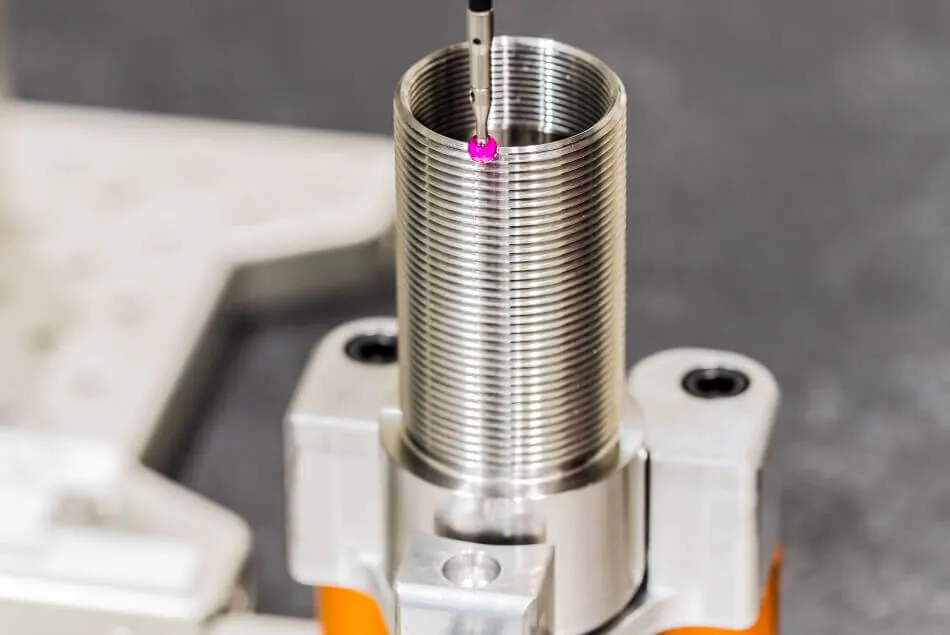
Quality assurance is embedded into every stage of manufacturing. All critical dimensions are verified using Coordinate Measuring Machine (CMM) inspection, ensuring compliance with ISO 10360 standards. Our CMM systems provide full 3D metrology reports, traceable to international calibration standards, supporting AS9100 and ISO 9001 compliance for regulated industries. Each part undergoes first-article inspection and in-process checks, with final certification available upon request. This rigorous inspection protocol guarantees that every component meets the specified geometric dimensioning and tolerancing (GD&T) requirements.
The combination of advanced CNC control, precision tooling, and metrology-backed validation enables Wuxi Lead to achieve industry-leading tolerances in steel sheet bending. Below is a summary of our standard and achievable capabilities under controlled conditions.
| Parameter | Standard Tolerance | High-Precision Capability |
|---|---|---|
| Linear Dimension (mm) | ±0.1 mm | ±0.05 mm |
| Bend Angle | ±0.5° | ±0.2° |
| Bend Length | ±0.2 mm | ±0.1 mm |
| Hole-to-Feature Position | ±0.15 mm | ±0.08 mm |
| Flatness (per 100 mm) | 0.1 mm | 0.05 mm |
| Parallelism | 0.15 mm | 0.07 mm |
| Perpendicularity | 0.12 mm | 0.06 mm |
| Surface Roughness (Ra) | 3.2 µm | 1.6 µm |
These specifications reflect our commitment to precision engineering and process control. Wuxi Lead Precision Machinery ensures that every steel sheet bending project benefits from integrated design validation, advanced CNC forming, and certified quality inspection—delivering components that meet the most stringent performance requirements.
Material & Finish Options

Material Selection for Precision Steel Sheet Bending
Selecting the optimal material is fundamental to achieving precision, efficiency, and cost-effectiveness in sheet metal bending operations. At Wuxi Lead Precision Machinery, our decades of experience with high-tolerance bending reveal that material properties directly dictate tooling requirements, machine force calculations, springback compensation, and achievable geometries. Misalignment between material characteristics and bending parameters leads to part rejection, tool damage, and production delays. This guide focuses on key engineering metals and critical surface finish considerations relevant to bending processes.
Aluminum Alloys offer excellent formability and low weight but present unique bending challenges. Common grades like 5052-H32 and 6061-T6 are widely used. Softer tempers (e.g., H32) bend more easily with minimal springback but may show surface imperfections. Harder tempers (e.g., T6) require significantly higher tonnage, exhibit pronounced springback (often 2-3x that of mild steel), and are prone to cracking at tight bend radii, especially across the grain. Minimum bend radii must exceed 1.5x material thickness for T6 alloys to prevent fracture. Aluminum’s lower yield strength compared to steel necessitates careful tooling setup to avoid buckling.
Carbon and Alloy Steels, particularly mild steel (e.g., AISI 1008, 1010), remain the workhorse for bending due to predictable behavior and cost efficiency. Their higher yield strength provides good structural integrity but demands greater press force. Springback is moderate and highly consistent, allowing for precise compensation in CNC programming. High-strength low-alloy (HSLA) steels and stainless grades (e.g., 304, 316) require specialized tooling and significantly increased tonnage. Stainless steel exhibits higher springback and work-hardening tendencies, necessitating slower bending speeds and potentially larger bend radii to avoid cracking.
Titanium Alloys, while offering exceptional strength-to-weight ratio and corrosion resistance, are exceptionally challenging to bend. Their high strength, low modulus of elasticity, and significant springback (up to 5x mild steel) demand specialized, robust tooling and high-capacity machinery. Titanium is highly susceptible to galling and surface damage during bending, requiring meticulous lubrication and often coated tooling. Minimum bend radii are typically 3-5x material thickness. Bending titanium is generally reserved for critical aerospace or medical applications where its properties justify the complexity and cost.
Anodizing as a Post-Bend Finish
Anodizing is a critical surface treatment for aluminum components, enhancing corrosion resistance, wear properties, and enabling coloration. Crucially, anodizing must always be performed after all bending and forming operations. The anodized layer is hard but brittle; bending aluminum post-anodization will inevitably cause the coating to crack and spall, compromising both aesthetics and protection. Ensure parts are thoroughly cleaned and deburred pre-anodizing to achieve a uniform finish. Specify the required anodizing thickness (e.g., Type II – 0.7-25µm, Type III – Hardcoat 25-125µm) early, as thicker coatings can influence tight tolerance fits.
Material properties dictate bending success. Consult Wuxi Lead’s engineering team for specific grade recommendations and process validation based on your part geometry and performance requirements.
| Material Property | Aluminum 6061-T6 | Mild Steel (AISI 1008) | Titanium Grade 5 (Ti-6Al-4V) |
|---|---|---|---|
| Yield Strength (MPa) | 240-275 | 170-240 | 880-900 |
| Tensile Strength (MPa) | 290-325 | 280-340 | 900-950 |
| Min. Bend Radius (t) | ≥ 1.5t | ≥ 0.8t | ≥ 3.0t |
| Relative Springback | High (2-3x Steel) | Moderate | Very High (4-5x Steel) |
| Critical Bending Notes | Crack risk on tight bends; Lubrication essential for hard tempers | Predictable behavior; Standard tooling suitable | Extreme springback; Requires high tonnage; Mandatory lubrication; Prone to galling |
Manufacturing Process & QC

Design: Precision Engineering at the Core
The foundation of flawless steel sheet bending begins with meticulous design engineering. At Wuxi Lead Precision Machinery, every component’s journey starts with advanced 3D modeling and finite element analysis (FEA) to simulate real-world stress, deformation, and structural integrity. Our engineering team collaborates closely with clients to interpret technical drawings, material specifications, and functional requirements. Utilizing CAD/CAM software such as SolidWorks and AutoCAD, we generate precise digital models that define bend angles, radii, tolerances, and sequence of operations. This phase ensures compatibility with our CNC press brakes and eliminates geometric conflicts before any metal is cut. Design validation includes clearance checks, spring-back compensation, and tooling path optimization to guarantee repeatability and dimensional accuracy across production batches.
Prototyping: Validating Performance Before Scale
Once the design is finalized, we proceed to prototyping—a critical stage for verifying form, fit, and function. A small batch of parts is produced using the same CNC-controlled steel sheet bending machines intended for mass production. This ensures process consistency from prototype to full-scale manufacturing. Each prototype undergoes rigorous inspection using coordinate measuring machines (CMM), laser scanning, and manual gauging to confirm adherence to specified tolerances. Dimensional reports are shared with the client for approval. Any deviations trigger immediate root cause analysis and design or process refinement. This iterative validation loop ensures that only fully verified processes advance to mass production, significantly reducing the risk of defects downstream.
Mass Production: Zero Defects Through Process Control
With prototype approval, we transition to high-efficiency mass production under a zero-defect manufacturing philosophy. Our facility employs state-of-the-art CNC press brakes equipped with automatic tool changers, angle measurement systems (e.g., Delem or Cybelec controls), and real-time feedback loops. Each machine is programmed directly from the approved CAD model, minimizing human error. In-process quality checks occur at defined intervals, supported by Statistical Process Control (SPC) to monitor trends and maintain consistency. All operators are trained to ISO 9001 standards and follow documented work instructions. Material traceability, batch tracking, and final inspection ensure every component meets the exact specifications. Non-conforming parts are quarantined and analyzed through our corrective action system to prevent recurrence.
Key Equipment Specifications
| Parameter | Specification |
|---|---|
| Bending Force Range | 35 to 600 tons |
| Max Bending Length | 1,250 to 6,000 mm |
| Material Thickness Capacity | 0.5 to 12 mm (mild steel) |
| Positioning Accuracy | ±0.05 mm |
| Repeatability | ±0.1 degree angular accuracy |
| Control System | Delem DA-66T / Cybelec DNC 6S |
| Tooling Compatibility | Standard ISO 2747, segmented and multi-V dies |
| Production Speed | Up to 15 bends per minute (automated setup) |
This integrated approach—spanning precision design, verified prototyping, and tightly controlled mass production—ensures consistent, defect-free output tailored to demanding industrial applications.
Why Choose Wuxi Lead Precision
Elevate Your Metal Fabrication Capabilities with Lead Precision Engineering
When precision tolerances slip and production bottlenecks threaten delivery timelines, the cost of substandard bending equipment extends far beyond machine acquisition. In high-stakes custom metal manufacturing, your bending solution must deliver uncompromising accuracy, operational resilience, and seamless integration into complex workflows. Wuxi Lead Precision Machinery exists to eliminate these critical pain points through engineered excellence, not just equipment supply. We partner with forward-thinking manufacturers who demand more than a machine—they require a strategic asset engineered for peak performance under real-world production demands.
Our steel sheet bending machines integrate German-engineered kinematics with intelligent control architecture, ensuring micron-level repeatability across high-volume runs. Unlike generic solutions, Lead Precision systems feature adaptive crowning technology that dynamically compensates for material deflection, eliminating manual adjustments and scrap generation. This translates directly to reduced setup times, consistent part quality within ±0.02mm, and maximized spindle utilization—critical metrics for profitability in aerospace, energy, and heavy industrial sectors. We engineer for your specific material challenges, whether processing ultra-high-strength steel alloys or thin-gauge specialty metals requiring zero surface marking.
The technical foundation of our partnership is evident in core performance specifications designed for demanding applications:
| Specification | Performance Metric | Industrial Relevance |
|---|---|---|
| Max Tonnage | 1250 Tons | Handles thick-section structural steel |
| Stroke Length | 420 mm | Accommodates deep-draw components |
| Positioning Accuracy | ±0.01 mm | Ensures weld-ready part consistency |
| Backgauge Range | 0–1250 mm | Supports complex multi-bend geometries |
| Control System | Siemens 840D Solution | Enables IoT connectivity & predictive maintenance |
This isn’t merely specification sheet superiority—it’s proven operational value. Our clients report 30% faster changeovers and 22% higher OEE within six months of deployment, directly attributable to our focus on machine intelligence and service integration. Lead Precision engineers collaborate with your team from initial process audit through installation and operator certification, ensuring your investment delivers immediate ROI.
The competitive landscape for precision metal fabrication demands partners who understand that machine capability is only the starting point. True advantage comes from responsive engineering support, lifecycle cost management, and technology that evolves with your requirements. We commit to being that partner—providing not just equipment, but the operational certainty your business requires.
Do not accept compromises in a process that defines your product’s structural integrity. Contact our engineering sales team today to discuss your specific bending challenges. Email [email protected] with your material specifications and production volume requirements. A Lead Precision applications engineer will respond within 24 business hours with a tailored capability assessment—not a generic brochure. Transform your bending operations from a cost center into a competitive differentiator. Your next high-margin contract depends on the precision you deliver today.
⚙️ Precision Cost Estimator
Estimate relative manufacturing effort based on tolerance.