Commercial 3D Printing Services Manufacturer | Precision CNC Guide

Engineering Guide: Commercial 3D Printing Services

commercial 3d printing services manufacturing

Engineering Insight: Precision as the Non-Negotiable Core of Commercial Metal 3D Printing

In the realm of commercial metal additive manufacturing (AM), particularly for demanding B2B applications, precision transcends mere specification—it is the foundational requirement dictating component viability, performance, and safety. Unlike prototyping, end-use parts produced via processes like Laser Powder Bed Fusion (LPBF) or Electron Beam Melting (EBM) must consistently meet exacting dimensional tolerances, surface finish criteria, and critical metallurgical properties. Variability in layer thickness control, thermal management, or powder characteristics directly impacts part density, mechanical strength, fatigue resistance, and ultimately, functional reliability. For industries like aerospace, medical implantation, and high-performance automotive, where failure is not an option, the margin for error in metal AM is measured in microns, not millimeters. Achieving this level of repeatability demands far more than sophisticated hardware; it requires deep process mastery, rigorous in-situ monitoring, and a culture of uncompromising quality control embedded throughout the manufacturing workflow.

Wuxi Lead Precision Machinery operates at this critical precision frontier. Our engineering team possesses extensive, proven experience delivering mission-critical metal AM components where absolute dimensional stability and material integrity are paramount. This expertise is validated through stringent projects, including the production of specialized titanium components for Olympic torch assemblies requiring flawless thermal performance and aesthetic precision under extreme conditions, and the fabrication of complex, lightweight structural elements for advanced military aerospace platforms demanding exceptional strength-to-weight ratios and fatigue life. These applications underscore a fundamental truth: commercial metal 3D printing services for high-value sectors are only viable when underpinned by demonstrable, auditable precision across every build layer and post-processing step. It is not sufficient to print a part; it must be printed correctly, consistently, and certified to the highest industry standards.

Our commitment to precision is quantifiable through controlled process parameters and advanced metrology. We leverage real-time melt pool monitoring, adaptive layer correction, and comprehensive post-build validation using coordinate measuring machines (CMM) and computed tomography (CT) scanning to ensure every component meets or exceeds client specifications. The table below outlines key capabilities inherent to our certified metal AM production system:

Parameter Capability Range Significance for Precision
Layer Thickness 20 – 60 μm Directly impacts surface finish and feature resolution
Dimensional Accuracy ± 25 μm (typical), down to ± 15 μm Ensures fit, function, and assembly integrity
Surface Roughness (As-Built) Ra 8 – 15 μm Critical for fatigue performance and fluid dynamics
Build Volume Up to Ø 250 x 325 mm (LPBF) Enables complex, near-net-shape production
Material Options Ti6Al4V, Inconel 718, 316L, AlSi10Mg, CoCr, Maraging Steel Metallurgical integrity verified per AMS/ASTM
Post-Processing HIP, Stress Relief, Precision Machining, Polishing Achieves final dimensional specs and surface quality

Precision in commercial metal 3D printing is not an incremental advantage; it is the absolute prerequisite for adoption in engineering-critical applications. Wuxi Lead Precision Machinery’s proven track record in delivering components for the world’s most demanding events and defense systems demonstrates our operational mastery of this principle. We transform the potential of additive manufacturing into reliable, high-performance reality through relentless focus on measurable accuracy and material science. Partner with us to ensure your metal AM parts meet the uncompromising standards required for success. Contact our engineering team to discuss your precision-critical project requirements.


Precision Specs & Tolerances

commercial 3d printing services manufacturing

Wuxi Lead Precision Machinery delivers advanced technical capabilities in custom metal manufacturing, engineered to meet the exacting demands of high-performance industries such as aerospace, medical, energy, and precision automation. At the core of our production infrastructure is our 5-axis CNC machining technology, which enables the creation of complex, high-precision metal components with superior surface finishes and dimensional accuracy. Unlike conventional 3-axis systems, our 5-axis CNC platforms allow simultaneous movement across five axes, minimizing setup cycles and enabling the machining of intricate geometries in a single operation. This capability significantly reduces lead times, improves repeatability, and ensures consistency across both prototyping and full-scale production runs.

Our machining centers are equipped with high-speed spindles, advanced tooling systems, and real-time monitoring software to maintain optimal cutting conditions. We work with a broad range of engineering metals, including titanium, stainless steel, aluminum alloys, Inconel, and tool steels, supporting diverse application requirements from high-temperature resistance to biocompatibility. Each machining process is supported by comprehensive digital planning using CAD/CAM integration, ensuring precision in toolpath generation and collision avoidance.

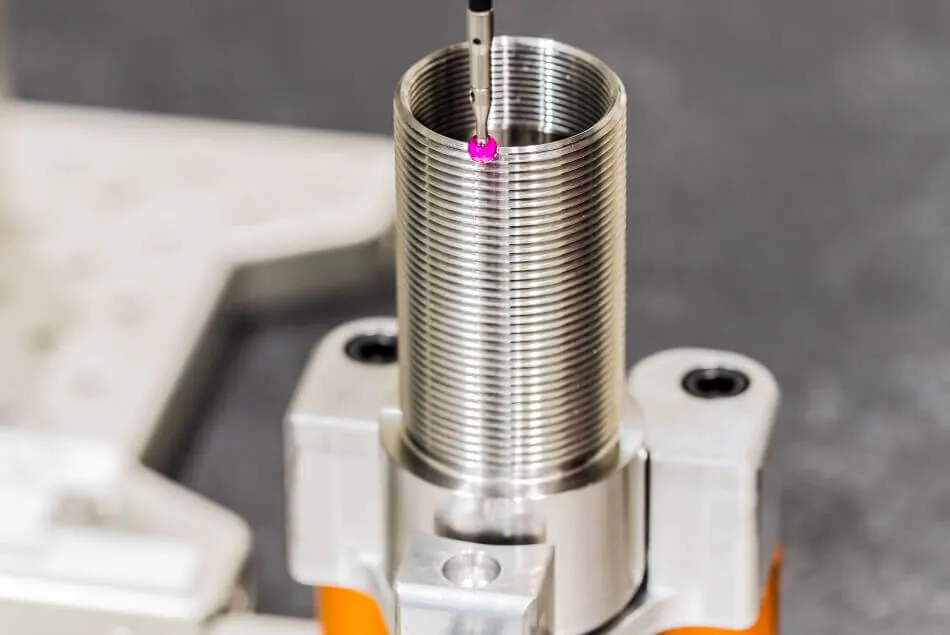
Quality control is integral to our manufacturing philosophy. Every component undergoes rigorous inspection using a Coordinate Measuring Machine (CMM) to verify dimensional conformity and geometric accuracy. Our CMM systems operate with sub-micron resolution, enabling traceable, certified measurement reports aligned with ISO 10360 standards. These inspections cover critical features such as positional tolerances, flatness, roundness, and profile deviations, ensuring compliance with customer technical drawings and international quality benchmarks. In addition to CMM validation, we employ surface roughness testers, optical comparators, and metallurgical analysis tools as part of our multi-stage quality assurance protocol.

The following table outlines the standard technical specifications and tolerances achievable through our 5-axis CNC machining and inspection processes:

Parameter Standard Capability Tight Tolerance Option Measurement Method
Linear Dimensional Tolerance ±0.010 mm ±0.005 mm CMM, High-Precision Micrometers
Geometric Tolerance (GD&T) ±0.015 mm (Position, Profile) ±0.008 mm CMM, Optical Comparator
Surface Roughness (Ra) 1.6 µm 0.4 µm (Polished Finish) Surface Roughness Tester
Maximum Work Envelope 1,200 x 800 x 600 mm Custom fixturing available CNC Machine Specifications
Angular Accuracy ±0.02° ±0.01° CMM, Precision Probes
Repeatability ±0.008 mm ±0.003 mm Statistical Process Control

All processes are conducted under ISO 9001-certified quality management systems, with full documentation and inspection reports provided upon request. Wuxi Lead Precision Machinery combines cutting-edge equipment, stringent quality control, and deep engineering expertise to deliver metal components that meet the highest standards of precision and reliability.


Material & Finish Options

commercial 3d printing services manufacturing

Material Selection for High-Performance Metal Additive Manufacturing

Selecting the optimal material is fundamental to achieving functional performance, cost efficiency, and longevity in commercial metal 3D printing applications. At Wuxi Lead Precision Machinery, our production experience confirms that aluminum, steel, and titanium alloys dominate demanding sectors like aerospace, medical implants, and energy due to their distinct mechanical and thermal properties. Misalignment between material characteristics and end-use requirements inevitably leads to premature failure or unnecessary expenditure.

Aluminum alloys, particularly AlSi10Mg and 7075, deliver an exceptional strength-to-weight ratio essential for weight-sensitive components such as drone frames and automotive brackets. These materials exhibit excellent thermal conductivity and corrosion resistance but require careful post-processing to achieve tight tolerances. For applications demanding higher hardness and wear resistance, maraging steel (e.g., 18Ni300) and stainless steel 17-4PH are preferred. These alloys maintain structural integrity under high stress and elevated temperatures, making them ideal for hydraulic manifolds, tooling inserts, and aerospace landing gear components. Titanium Grade 5 (Ti6Al4V) remains unmatched for biocompatibility and strength in corrosive environments. Its use in orthopedic implants, marine hardware, and jet engine parts leverages its fatigue resistance and near-chemical inertness, though powder handling requires stringent moisture control.

Surface finishing, especially anodizing for aluminum, is not merely aesthetic but a critical performance enhancer. Type II (sulfuric acid) anodizing provides moderate corrosion and wear resistance for general industrial use, while Type III (hardcoat) anodizing delivers thicker, denser oxide layers (25–50μm) suitable for hydraulic pistons or marine connectors exposed to abrasive or saline conditions. Anodizing depth must align with dimensional tolerances, as the process consumes substrate material.

The following table summarizes key mechanical properties for common production alloys:

Material Yield Strength (MPa) Density (g/cm³) Key Applications
AlSi10Mg 220–280 2.67 Lightweight brackets, heat exchangers
17-4PH Stainless 950–1200 7.80 Valve bodies, pump components
Ti6Al4V (Grade 5) 880–950 4.43 Surgical implants, aircraft fittings

Material choice directly impacts build strategy, support structure design, and post-processing workflows. For instance, titanium’s slow cooling rate necessitates controlled inert gas environments to prevent embrittlement, while steel alloys often require hot isostatic pressing (HIP) to eliminate internal porosity. Wuxi Lead Precision Machinery integrates material science expertise with proprietary process parameters to ensure microstructural consistency. We collaborate with clients during the design phase to match alloy selection with operational loads, environmental exposure, and regulatory standards—avoiding costly iterations. Contact our engineering team to determine the optimal material and finishing protocol for your next high-value component.


Manufacturing Process & QC

commercial 3d printing services manufacturing

Design: Precision Engineering at the Foundation

At Wuxi Lead Precision Machinery, the production process begins with meticulous design engineering, where precision is not an outcome but a requirement. Our engineering team collaborates directly with clients to analyze part geometry, functional requirements, material properties, and environmental conditions. Leveraging advanced CAD/CAM software and finite element analysis (FEA), we optimize designs for structural integrity, manufacturability, and performance under real-world loads. Every design undergoes rigorous digital simulation to predict stress distribution, thermal behavior, and fatigue life, ensuring that no physical prototype is produced without first achieving virtual validation. This stage is critical in eliminating potential failure points before any metal is cut, aligning with our zero-defect philosophy from the outset.

Prototyping: Validating Performance Before Scale

Once the design is finalized, we proceed to prototyping using selective laser melting (SLM) and direct metal laser sintering (DMLS) technologies. These industrial-grade additive processes allow us to produce fully dense, functional metal parts in materials such as titanium (Ti6Al4V), Inconel 718, stainless steel 316L, and aluminum AlSi10Mg. Prototypes are not merely visual models—they are engineered to match the mechanical properties of final production components. Each prototype undergoes comprehensive metrology testing using coordinate measuring machines (CMM), optical scanning, and metallurgical analysis to verify dimensional accuracy, surface integrity, and microstructure consistency. Any deviations trigger immediate design or process adjustments, ensuring seamless transition to mass production.

Mass Production: Scalable Precision with Zero Defects

Our mass production phase is built on automation, real-time monitoring, and closed-loop quality control systems. Utilizing a fleet of industrial 3D printers with consistent build parameters, we maintain batch-to-batch repeatability within ±0.02 mm. Each layer during printing is monitored via in-situ sensors that detect anomalies in melt pool stability, thermal gradients, and powder distribution. If any parameter falls outside the defined tolerance window, the system triggers corrective action or halts production—ensuring defective parts are never produced. Post-processing, including heat treatment, hot isostatic pressing (HIP), and precision machining, follows standardized workflows validated under ISO 9001 and AS9100 quality standards.

All finished components undergo 100% inspection using non-destructive testing (NDT) methods such as X-ray computed tomography (CT) and ultrasonic testing. Final dimensional reports, material certifications, and traceability logs are provided with every shipment, guaranteeing full compliance and audit readiness.

Parameter Specification
Material Options Ti6Al4V, Inconel 718, 316L Stainless Steel, AlSi10Mg, Maraging Steel
Layer Thickness 20–60 μm
Build Volume (Max) 500 x 500 x 500 mm
Dimensional Accuracy ±0.02 mm
Surface Roughness (as-built) Ra 8–12 μm (can be reduced to Ra 1–2 μm with polishing)
Quality Standards ISO 9001, AS9100, NDT-Compliant (X-ray, CMM, UT)

Through integrated design validation, rigorous prototyping, and flaw-intolerant mass production, Wuxi Lead ensures every component meets the highest standards of performance, reliability, and consistency—delivering true zero-defect manufacturing for critical applications in aerospace, medical, and high-performance industrial sectors.


Why Choose Wuxi Lead Precision

Why Partner With Lead Precision for Commercial Metal 3D Printing

The global shift toward complex, high-performance metal components demands more than standard additive manufacturing. Legacy suppliers often struggle with inconsistent quality, extended lead times, and limited post-processing capabilities—critical gaps when producing mission-critical aerospace, medical, or energy parts. At Wuxi Lead Precision Machinery, we bridge these gaps through integrated engineering rigor and industrial-scale metal 3D printing. Our facility operates under ISO 9001 and AS9100 certifications, ensuring every component meets stringent aerospace, defense, and medical standards. Unlike competitors reliant on outsourced finishing, we control the entire workflow: from design optimization and laser powder bed fusion to precision CNC machining, heat treatment, and surface engineering. This vertical integration eliminates supply chain vulnerabilities while guaranteeing repeatability and traceability down to the material batch level.

Our technical capabilities are engineered for real-world industrial challenges. We specialize in producing geometrically intricate parts with properties matching or exceeding traditionally forged equivalents—critical for applications requiring fatigue resistance, thermal stability, or biocompatibility. The table below outlines our core production specifications for commercial metal additive services:

Capability Specification Application Impact
Build Volume 500 x 500 x 400 mm Large structural aerospace components
Layer Thickness 20–60 μm adjustable Fine surface finish on medical implants
Material Range Ti-6Al-4V, Inconel 718, 316L, AlSi10Mg High-temp turbine parts & lightweight structures
Dimensional Accuracy ±0.05 mm (after post-processing) Direct assembly without rework
Surface Roughness (As-Built) Ra 12–25 μm Reduced secondary machining time
Post-Processing In-house CNC, HIP, HIP, polishing Aerospace-certified fatigue performance

This precision translates to tangible outcomes: 37% faster time-to-prototype for Tier 1 aerospace clients, 99.2% first-pass yield on complex hydraulic manifolds, and full compliance with ASTM F75 and AMS 7000 standards. Our engineering team collaborates from initial design review through final inspection, leveraging simulation-driven process validation to eliminate costly iterations. When your project requires zero-defect reliability—whether for satellite propulsion systems or patient-specific orthopedic devices—Lead Precision delivers certified performance, not just printed parts.

Initiate your precision manufacturing project with a partner who treats your specifications as non-negotiable. Contact our engineering team directly at [email protected] to submit technical drawings or request a capacity assessment. Include your target material, volume requirements, and quality certifications for a tailored production roadmap within 24 business hours. For urgent RFQs, reference project code LP-AM2024 to expedite technical validation. Wuxi Lead Precision Machinery: Where additive innovation meets industrial accountability.


⚙️ Precision Cost Estimator

Estimate relative manufacturing effort based on tolerance.

Commercial 3D Printing Services Manufacturer | Precision CNC Guide

Contents of Table

Contact [email protected] Whatsapp 86 15951276160