Technical Contents
Engineering Guide: Weight Titanium Vs Steel

Engineering Insight: Weight Titanium vs Steel
In high-performance manufacturing, the decision between titanium and steel is rarely arbitrary. It is a calculated engineering choice driven by application demands, environmental conditions, and precision requirements. At Wuxi Lead Precision Machinery, we understand that material selection directly impacts part integrity, longevity, and performance—especially in sectors such as aerospace, defense, and elite sports equipment where our components have been trusted by Olympic teams and military contractors.
One of the most critical distinctions between titanium and steel lies in their weight-to-strength ratio. Titanium, while approximately 45% lighter than steel, offers comparable tensile strength in many grades. This makes it exceptionally valuable in applications where weight reduction is paramount without sacrificing durability. For example, in aerospace components or high-end racing systems, reducing mass can significantly enhance fuel efficiency, speed, and maneuverability. However, titanium’s lower modulus of elasticity means it is more flexible under load, which requires tighter control during machining to maintain dimensional accuracy.
Steel, particularly high-grade alloys like 4140 or 17-4 PH, provides superior hardness, wear resistance, and stability under extreme stress. It is often the preferred choice for structural components, tooling, and applications exposed to high abrasion. Yet, its higher density can be a limiting factor in weight-sensitive designs. The challenge for manufacturers is not only selecting the right material but also ensuring that the precision of the final part meets exacting tolerances—often within ±0.005 mm or tighter.
At Wuxi Lead, our expertise in CNC machining allows us to handle both materials with equal mastery. Titanium’s low thermal conductivity demands specialized toolpaths and cooling strategies to prevent heat buildup and work hardening. Steel’s toughness requires robust tooling and high-torque machining to achieve clean, burr-free finishes. Our decades of experience, refined through projects for defense systems and Olympic-grade equipment, enable us to anticipate material behavior and adjust parameters in real time, ensuring repeatability and consistency across production runs.
The table below outlines key mechanical properties to consider when evaluating titanium versus steel for precision components:
| Property | Titanium (Grade 5, Ti-6Al-4V) | Steel (4140 Alloy) |
|---|---|---|
| Density (g/cm³) | 4.43 | 7.85 |
| Tensile Strength (MPa) | 900–1,100 | 850–1,000 |
| Yield Strength (MPa) | 830–860 | 655–700 |
| Modulus of Elasticity (GPa) | 114 | 205 |
| Thermal Conductivity (W/m·K) | 6.7 | 41.6 |
| Machinability Rating | 30–40% | 70–80% |
Precision is not just about tight tolerances—it is about understanding how material properties interact with design intent and operational environment. At Wuxi Lead Precision Machinery, we combine advanced CNC technology with deep metallurgical insight to deliver components that perform under the most demanding conditions. Whether you’re optimizing for weight, strength, or longevity, our team ensures your vision is manufactured to perfection.
Precision Specs & Tolerances

Technical Capabilities: Precision Machining of Titanium and Steel
At Wuxi Lead Precision Machinery, our advanced 5-axis CNC machining centers form the cornerstone of high-integrity component production for demanding aerospace, medical, and energy applications. These state-of-the-art systems enable simultaneous multi-directional cutting, critical for complex geometries inherent in titanium and steel components. Titanium’s low thermal conductivity and high strength demand specialized toolpaths to manage heat dissipation and prevent work hardening, while steel’s toughness requires optimized feed rates to minimize tool wear and burr formation. Our Haas and DMG MORI 5-axis platforms integrate adaptive control systems that dynamically adjust parameters in real-time, ensuring consistent surface finishes and dimensional stability across both materials. This capability eliminates secondary operations, reducing lead times by up to 40% compared to conventional 3-axis methods.
Material-specific expertise defines our process rigor. For titanium alloys like Ti-6Al-4V, we employ high-pressure coolant delivery and rigid clamping to counteract elastic deformation during machining. Steel variants—including 4140, 17-4PH, and tool steels—are processed with interrupted-cut optimized tooling to manage chip evacuation and prevent re-cutting. Each program undergoes virtual simulation to verify collision avoidance and material removal efficiency, particularly vital for titanium’s cost-sensitive stock. Our facility maintains strict environmental controls, with temperature-stabilized machining cells minimizing thermal drift that could compromise micron-level tolerances.
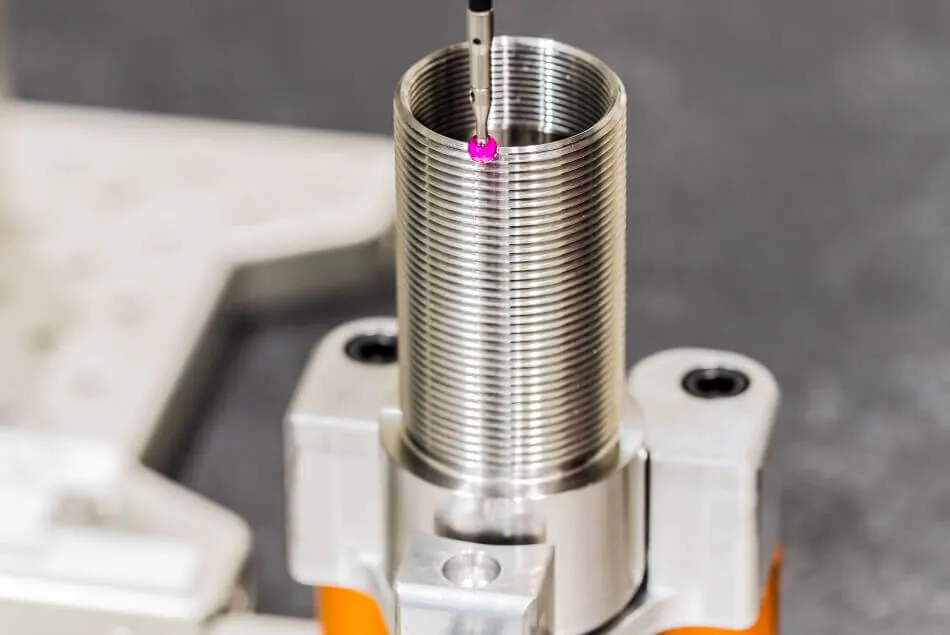
Quality assurance is non-negotiable. Every component undergoes comprehensive Coordinate Measuring Machine (CMM) inspection using Zeiss CONTURA systems, validating geometric dimensioning and tolerancing (GD&T) against ASME Y14.5 standards. For titanium, we verify microstructure integrity via post-machining ultrasonic testing to detect subsurface anomalies. Steel parts receive hardness mapping and residual stress analysis to ensure performance under cyclic loads. This dual-material validation protocol guarantees compliance with NADCAP and ISO 13485 requirements, providing clients with full traceability from raw material certs to final inspection reports.
Our proven tolerances reflect material-specific machining mastery, as demonstrated below:
| Parameter | Titanium Alloys (e.g., Ti-6Al-4V) | Steel Alloys (e.g., 4140, 17-4PH) |
|---|---|---|
| Standard Dimensional Tolerance | ±0.005 mm (±0.0002″) | ±0.003 mm (±0.0001″) |
| Geometric Tolerance (Flatness) | 0.010 mm per 100 mm | 0.005 mm per 100 mm |
| Surface Roughness (Ra) | 0.8 µm (32 µin) achievable | 0.4 µm (16 µin) achievable |
| Critical Feature Control | Springback compensation applied | Burr-free edges per ISO 13715 |
| Max. Part Size | Ø 800 mm x 600 mm height | Ø 1000 mm x 800 mm height |
This precision is engineered into every project through our closed-loop manufacturing system, where CMM data feeds directly into CNC offset corrections for batch consistency. For clients selecting between titanium and steel, our engineering team provides material suitability analysis—balancing weight savings, fatigue resistance, and lifecycle costs against machinability constraints. By mastering the interplay of material science and micron-accurate production, Wuxi Lead transforms design intent into mission-critical components that perform reliably in extreme environments. Partner with us to leverage capabilities that turn material challenges into competitive advantages.
Material & Finish Options

Material selection is a critical step in precision manufacturing, directly influencing the performance, durability, and cost-efficiency of final components. At Wuxi Lead Precision Machinery, we specialize in custom metal manufacturing, supporting industries such as aerospace, medical devices, and high-performance automotive systems with engineered solutions. Among the most commonly specified materials are aluminum, steel, and titanium—each offering distinct advantages depending on the application. Understanding their mechanical properties, weight characteristics, and compatibility with finishing processes like anodizing is essential for optimal design outcomes.
Titanium stands out for its exceptional strength-to-density ratio, corrosion resistance, and performance at elevated temperatures. It is approximately 45% lighter than steel while maintaining comparable tensile strength in many grades. This makes titanium ideal for weight-sensitive applications where structural integrity under stress and exposure to harsh environments is required. However, titanium’s higher raw material cost and challenging machinability demand advanced CNC capabilities and experienced process planning—areas where Wuxi Lead excels through our precision milling and turning services.
Steel, particularly alloy and stainless variants, remains a staple in industrial applications due to its high strength, wear resistance, and cost-effectiveness. While significantly denser than both titanium and aluminum, steel provides unmatched durability in load-bearing and high-impact scenarios. Its magnetic properties and weldability further broaden its utility across mechanical and structural systems. When corrosion resistance is a concern, stainless steel grades such as 304 and 316 offer reliable performance without the need for additional coatings in many environments.
Aluminum is the lightest of the three, weighing about one-third as much as steel. It offers good machinability, thermal conductivity, and excellent response to anodizing—a key advantage in both functional and aesthetic applications. Anodized aluminum surfaces gain enhanced hardness, wear resistance, and the ability to retain color for identification or branding. While aluminum’s strength is lower than steel or titanium, high-strength alloys like 7075 can approach the performance of mild steel, making them suitable for aerospace and transportation components where weight reduction is paramount.
The following table summarizes key physical and mechanical properties of representative grades:
| Material | Density (g/cm³) | Tensile Strength (MPa) | Yield Strength (MPa) | Corrosion Resistance | Anodizing Compatible |
|---|---|---|---|---|---|
| Aluminum 6061 | 2.7 | 310 | 276 | Moderate | Yes |
| Steel 4140 | 7.85 | 655 | 415 | Low (uncoated) | No |
| Stainless 304 | 8.0 | 505–860 | 215–310 | High | Limited |
| Titanium Gr5 | 4.43 | 895 | 828 | Very High | Yes (special process) |
Selecting the right material involves balancing weight, strength, environmental exposure, and finishing requirements. At Wuxi Lead Precision Machinery, we support clients through material consultation, prototyping, and high-accuracy production to ensure optimal component performance. Whether prioritizing lightweight design with titanium or cost-effective strength with steel, our engineering team delivers precision-manufactured parts to exacting global standards.
Manufacturing Process & QC
Precision Manufacturing Process: Titanium vs Steel for Weight-Critical Applications
Material selection between titanium and steel fundamentally shapes the entire production pathway at Wuxi Lead Precision Machinery. Achieving zero defects in weight-sensitive components demands a rigorously controlled sequence from initial concept through to high-volume output. Our process integrates deep material science understanding with advanced CNC manufacturing to ensure optimal performance and reliability.
The design phase begins with intensive collaboration. Engineers analyze the component’s functional requirements, environmental exposure, and critical weight targets. Titanium’s superior strength-to-weight ratio (approximately 45% lighter than steel at equivalent strength) often makes it ideal for aerospace or medical implants, while specific high-strength steels may suffice for less extreme weight constraints. Finite Element Analysis (FEA) simulates stress points under load, guiding geometry optimization. Crucially, machinability characteristics are factored in early; titanium’s low thermal conductivity and tendency to gall necessitate different toolpath strategies and fixture designs compared to most steels. This stage establishes the blueprint for defect prevention.
Prototyping validates both design and process. We fabricate initial units using the exact alloys and planned CNC methodologies. Titanium prototyping requires meticulous attention: lower cutting speeds, rigid setups to prevent chatter, specialized coolant application to manage heat, and sharp, carbide tooling with specific geometries to avoid work hardening. Steel prototypes, while generally more forgiving, still undergo rigorous dimensional and metallurgical checks. Each prototype undergoes comprehensive Coordinate Measuring Machine (CMM) inspection, non-destructive testing (NDT) like X-ray or ultrasonic for internal integrity, and functional validation. Feedback from this stage directly refines the mass production program, eliminating potential failure modes before scale-up.
Mass production executes the perfected process under our Zero Defects Manufacturing System. For titanium, this means continuous in-process monitoring of tool wear and thermal conditions, automated part probing for critical dimensions after key operations, and 100% final inspection against AS9100 or equivalent standards. Steel production leverages high-speed machining capabilities but maintains identical stringent controls. Both materials flow through our integrated quality gates: automated optical inspection for surface defects, precise weight verification, and final CMM certification. Real-time data from CNC machines feeds our Statistical Process Control (SPC) system, enabling immediate correction of any drift. This closed-loop approach ensures every component, whether lightweight titanium or high-strength steel, meets the exacting tolerance and reliability demands of critical applications.
Material performance characteristics directly influence manufacturability and final part integrity. Key properties are summarized below:
| Property | Titanium (Grade 5 Ti-6Al-4V) | Steel (AISI 4140) | Manufacturing Impact |
|---|---|---|---|
| Density (g/cm³) | 4.43 | 7.85 | Titanium parts are ~43% lighter; critical for weight-sensitive assemblies. |
| Tensile Strength (MPa) | 900 – 1100 | 655 – 1000 | Titanium offers higher strength-to-weight; steel may require thicker sections. |
| Corrosion Resistance | Excellent (seawater, acids) | Moderate (rusts) | Titanium eliminates coating needs in harsh environments; steel requires protection. |
| Machinability Rating | Poor (20-30% of B1112 steel) | Good (Baseline) | Titanium demands slower speeds, rigid setups, specialized tooling; higher cost/part. |
Wuxi Lead’s integrated Design-Prototype-Production workflow, grounded in material-specific expertise and enforced by our Zero Defects protocol, transforms the theoretical advantages of titanium or steel into reliably manufactured, mission-critical components. We deliver not just parts, but guaranteed performance.
Why Choose Wuxi Lead Precision
When it comes to high-performance manufacturing, the choice between titanium and steel is not simply a matter of material preference—it’s a strategic decision that impacts strength, weight, durability, and cost-efficiency. At Wuxi Lead Precision Machinery, we specialize in custom metal manufacturing solutions that leverage advanced CNC machining, precision engineering, and deep metallurgical expertise to help clients make the optimal material selection for their specific applications.
Titanium offers a remarkable strength-to-density ratio, making it ideal for aerospace, medical implants, and high-stress automotive components where weight reduction is critical. It resists corrosion in extreme environments, including saltwater and high-temperature conditions, and maintains structural integrity under prolonged stress. However, titanium’s higher raw material cost and challenging machinability demand specialized tooling, slower cutting speeds, and experienced operators—factors that can significantly impact production timelines and budgets.
Steel, particularly high-grade alloys such as 4140, 17-4 PH, or tool steels, provides exceptional tensile strength, wear resistance, and dimensional stability. It is more cost-effective in both material and machining, making it a preferred choice for industrial tooling, heavy machinery components, and structural applications where weight is less of a constraint. With proper heat treatment and surface finishing, steel components can achieve performance levels that rival more exotic materials.
Understanding the trade-offs between titanium and steel requires not only technical knowledge but also hands-on manufacturing experience. At Wuxi Lead Precision Machinery, we combine state-of-the-art 5-axis CNC equipment with decades of precision engineering insight to deliver custom parts that meet exacting specifications—whether you’re optimizing for weight savings, longevity, or production cost.
Our team works closely with engineers and procurement leaders to evaluate your design requirements, environmental conditions, and lifecycle expectations. From prototype development to full-scale production, we ensure every component meets international quality standards, including ISO 9001:2015 certification, with full traceability and inspection documentation.
Below is a comparative overview of key mechanical properties for typical grades of titanium and steel used in precision manufacturing:
| Property | Titanium (Grade 5, Ti-6Al-4V) | Steel (AISI 4140, Heat Treated) |
|---|---|---|
| Density (g/cm³) | 4.43 | 7.85 |
| Tensile Strength (MPa) | 900–1,170 | 850–1,200 |
| Yield Strength (MPa) | 830–1,100 | 650–1,050 |
| Elongation at Break (%) | 10–15 | 12–18 |
| Corrosion Resistance | Excellent | Moderate (improved with plating) |
| Machinability Rating | 30–40% of steel | 100% (baseline) |
| Typical Applications | Aerospace, medical, racing | Tooling, shafts, industrial parts |
Choosing the right material is only half the equation. The real value lies in partnering with a manufacturer that understands how to transform raw material into precision-engineered components with consistency, speed, and reliability.
Partner with Wuxi Lead Precision Machinery to optimize your next project. Contact us today at [email protected] to discuss your requirements with our engineering team.
⚙️ Precision Cost Estimator
Estimate relative manufacturing effort based on tolerance.