

Technical Contents
Engineering Guide: 1018 Vs 1045 Steel
Engineering Insight: 1018 vs 1045 Steel: Precision Demands Dictate Material Choice
Selecting the optimal carbon steel alloy is a foundational engineering decision impacting manufacturability, performance, and final part integrity. For high-precision custom components, the distinction between 1018 and 1045 steel is not merely academic; it directly dictates machining strategy, achievable tolerances, and long-term reliability. At Wuxi Lead Precision Machinery, decades of experience producing mission-critical parts for Olympic-standard equipment and demanding military applications underscore that precision begins with intelligent material selection, not just advanced machinery.
1018 steel, a low-carbon alloy, offers excellent machinability and weldability due to its nominal 0.18% carbon content. This makes it ideal for complex geometries requiring tight tolerances during high-volume production runs where post-machining stress relief is feasible. Conversely, 1045 steel, classified as a medium-carbon steel with approximately 0.45% carbon, provides significantly higher strength and hardness in the as-rolled or normalized condition. This inherent strength is advantageous for high-wear applications but introduces challenges. The increased carbon content elevates hardness, reducing machinability and increasing tool wear. Crucially, 1045 is more susceptible to distortion during machining and welding without precise thermal management, directly threatening dimensional stability.
The critical factor for precision manufacturing lies in understanding how these material properties interact with stringent tolerance requirements. Achieving sub-0.005mm tolerances on a complex 1045 component demands meticulous control over cutting parameters, coolant application, and stress-relief cycles – far exceeding the process stability needed for comparable 1018 work. Machining 1045 near its final dimensions often necessitates additional heat treatment steps like quenching and tempering to reach target mechanical properties, introducing further potential for distortion that must be accounted for in the manufacturing sequence. 1018, while requiring less complex thermal management for basic strength, may lack the surface hardness needed for high-abrasion interfaces without case hardening.
Material selection must align precisely with the functional demands and the achievable precision envelope of the manufacturing process. The table below summarizes key comparative properties:
| Property | AISI 1018 Steel | AISI 1045 Steel |
|---|---|---|
| Carbon Content (wt%) | 0.15 – 0.20 | 0.43 – 0.50 |
| Tensile Strength (MPa) | 400 – 500 | 570 – 700 |
| Yield Strength (MPa) | 300 – 400 | 310 – 510 |
| Brinell Hardness (HB) | 126 – 140 | 170 – 210 |
| Machinability Rating | Excellent (72%) | Fair (63%) |
| Weldability | Very Good | Moderate (Preheat Req) |
| Typical Precision Applications | Non-critical shafts, spindles, brackets requiring tight tolerances | Gears, axles, studs, high-stress pins demanding strength & wear resistance |
Wuxi Lead’s proven capability in delivering components meeting Olympic timing system precision and military-grade durability stems from this granular understanding. We do not simply machine steel; we engineer solutions where material science, process control, and tolerance requirements are intrinsically linked. Choosing between 1018 and 1045 requires evaluating not just the end-use environment, but the entire precision manufacturing pathway. Partnering with an engineering-focused manufacturer ensures the selected alloy enables, rather than hinders, the achievement of your most demanding specifications. Precision is engineered from the first material specification.
Precision Specs & Tolerances
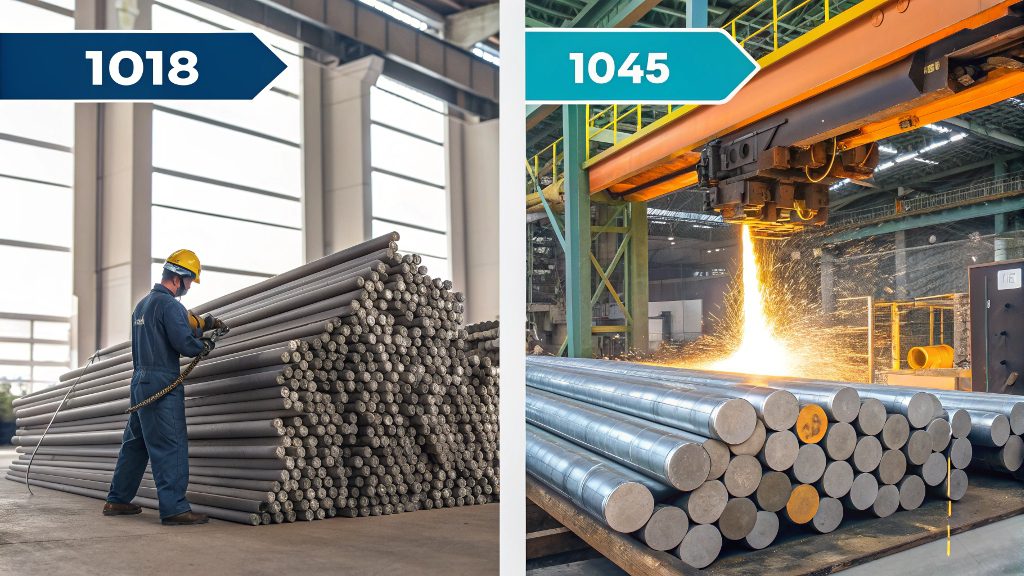
Wuxi Lead Precision Machinery delivers advanced custom metal manufacturing solutions tailored to the exacting demands of high-performance industries including aerospace, automotive, energy, and industrial automation. Our technical capabilities are anchored in state-of-the-art 5-axis CNC machining technology, enabling us to produce complex geometries with superior accuracy, surface finish, and repeatability. Unlike conventional 3-axis systems, our 5-axis platforms allow simultaneous movement across all five axes, minimizing setup cycles and eliminating the need for multiple fixtures. This results in tighter tolerances, reduced lead times, and exceptional part consistency—critical when working with engineering-grade steels such as 1018 and 1045.
Our machining centers are equipped with high-precision spindles, automated tool changers, and real-time monitoring systems to ensure optimal cutting conditions across diverse operations including milling, drilling, tapping, and contouring. These capabilities are especially effective when processing low-carbon 1018 steel, known for its excellent machinability and weldability, as well as medium-carbon 1045 steel, which offers higher strength and wear resistance but requires precise control during machining to manage hardness and tool wear. Our programming team utilizes advanced CAM software to optimize toolpaths, ensuring minimal material stress and maximum dimensional integrity—particularly important when transitioning between soft and hardened states of 1045 steel.
Quality assurance is integrated into every phase of production. All critical components undergo full inspection using our Zeiss coordinate measuring machine (CMM), providing metrology-grade verification of geometric dimensions and surface tolerances. This non-contact and tactile measurement system ensures compliance with international standards such as ISO 2768 and ASME Y14.5. In addition to first-article inspections, we perform in-process and final audits to validate consistency across production runs.
The following table outlines our standard machining tolerances and surface finish capabilities when processing carbon steels like 1018 and 1045 under controlled conditions.
| Parameter | Standard Tolerance | Precision Capability | Notes |
|---|---|---|---|
| Linear Dimensions (mm) | ±0.05 mm | ±0.01 mm | Up to 500 mm |
| Angular Tolerances | ±0.1° | ±0.05° | Measured via CMM |
| Positional Tolerance (Holes) | ±0.03 mm | ±0.01 mm | True position |
| Flatness | 0.05 mm | 0.02 mm per 100 mm | Verified on granite surface plate |
| Surface Roughness (Ra) | 3.2 µm | 0.8 µm | Achieved with fine finishing passes |
| Repeatability (Process Cpk) | ≥1.33 | ≥1.67 | Statistically validated |
With a foundation built on precision engineering, rigorous quality control, and deep metallurgical understanding, Wuxi Lead Precision Machinery ensures that every component manufactured from 1018 or 1045 steel meets the highest standards of performance and reliability.
Material & Finish Options
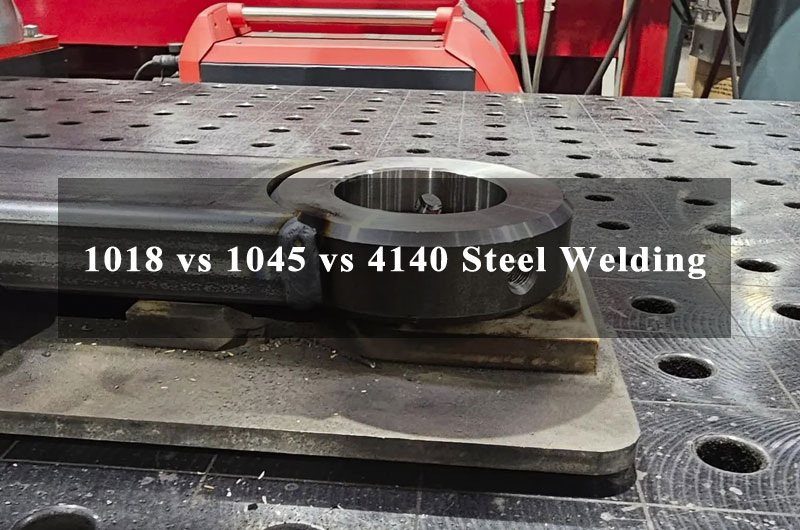
Material Selection: Engineering Steel Fundamentals for Precision Components
Selecting between 1018 and 1045 steel requires understanding how carbon content drives machinability, strength, and post-processing behavior in custom manufacturing. Both are low-alloy carbon steels widely used in shafts, pins, and structural parts, but their divergent carbon levels create critical performance gaps. At Wuxi Lead Precision Machinery, we prioritize material-process synergy to avoid costly rework or premature failure.
1018 steel contains 0.18% carbon, yielding excellent machinability with minimal tool wear. It chips cleanly during CNC milling or turning, requires no preheating for welding, and accepts cold working for simple bends. However, its low tensile strength (440 MPa) and Brinell hardness (126 HB) limit use in high-stress applications. Case hardening can surface-harden parts, but the core remains soft. Conversely, 1045 steel’s 0.45% carbon content doubles tensile strength (620 MPa) and hardness (180 HB), enabling load-bearing roles like hydraulic rods or gear shafts. This comes at a cost: reduced machinability demands slower feeds/speeds, increased tool deflection risks, and mandatory pre-weld heating to prevent cracking. Through-hardening via quenching is possible but requires precise thermal control to avoid distortion.
Key mechanical properties are summarized below for rapid comparison:
| Property | 1018 Steel | 1045 Steel |
|---|---|---|
| Carbon Content | 0.18% | 0.45% |
| Tensile Strength | 440 MPa | 620 MPa |
| Brinell Hardness | 126 HB | 180 HB |
| Machinability | Excellent (90%) | Moderate (60%) |
| Weldability | Good (no preheat) | Fair (preheat req) |
| Typical Applications | Non-critical brackets, spacers | Axles, couplings, high-wear pins |
For aluminum or titanium components, anodizing provides corrosion resistance and wear protection, but steel demands alternative finishes. 1018 benefits from zinc plating or powder coating for mild environments, while 1045 often requires induction hardening or nitriding to maximize surface durability in demanding service. Never assume interchangeability—using 1018 in a 1045-specified high-torque application risks catastrophic shear failure.
Wuxi Lead engineers validate material suitability against your load profiles, environmental exposure, and tolerance requirements. We optimize CNC parameters for each grade: 1018 allows aggressive material removal rates, while 1045 necessitates rigid setups and carbide tooling to manage stresses. Request our material-process compatibility checklist when submitting RFQs—avoiding mismatched steel selection prevents 30% of common production delays in custom fabrication. Precision begins with the right substrate.
Manufacturing Process & QC
Design: Precision Engineering for Optimal Material Utilization
At Wuxi Lead Precision Machinery, the production process begins with a rigorous design phase tailored to the mechanical and environmental demands of the final component. When selecting between 1018 and 1045 steel, engineers analyze key factors including load requirements, wear resistance, and desired hardness. 1018 steel, a low-carbon option, offers excellent machinability and weldability, making it ideal for parts requiring tight tolerances and complex geometries. In contrast, 1045, a medium-carbon steel, provides higher tensile strength and wear resistance, suitable for shafts, gears, and structural components subjected to dynamic stress. Finite element analysis (FEA) and 3D CAD modeling are employed to simulate performance under operational conditions, ensuring optimal material selection and geometry. All designs are validated through internal review protocols that align with ISO 9001 standards, minimizing risk before physical production begins.
Prototyping: Validating Performance and Fit
Following design approval, a prototype phase is initiated using CNC machining centers to produce functional samples from the selected steel grade. This stage is critical for verifying dimensional accuracy, surface finish, and assembly compatibility. For 1018 steel, the focus is on achieving smooth surface integrity and precise threading or slotting, leveraging its superior formability. For 1045, post-machining heat treatment—such as quenching and tempering—is applied to reach the desired hardness (typically 25–35 HRC), followed by stress-relief processes to prevent distortion. Each prototype undergoes metrological inspection using coordinate measuring machines (CMM) and optical comparators. Clients receive detailed inspection reports, including geometric dimensioning and tolerancing (GD&T) verification, enabling design refinement if necessary. This iterative validation ensures that only fully compliant designs advance to mass production.
Mass Production: Zero-Defect Manufacturing Execution
With prototype approval, production transitions to high-efficiency CNC turning and milling operations under a zero-defect manufacturing framework. Automated bar feeders, tool wear sensors, and real-time in-process gauging maintain consistency across batches. Statistical process control (SPC) monitors critical dimensions, with immediate feedback loops correcting deviations before non-conforming parts are produced. For 1045 steel components, heat treatment parameters are tightly controlled using calibrated furnaces and documented quenching media, ensuring uniform microstructure. All finished parts undergo 100% visual inspection and抽 spot testing for mechanical properties. Final packaging includes traceability labels linking each batch to material certificates and inspection data.
Mechanical Properties Comparison
| Property | 1018 Steel (AISI) | 1045 Steel (AISI) |
|---|---|---|
| Carbon Content (wt%) | 0.18 | 0.45 |
| Tensile Strength (MPa) | 440 | 570 |
| Yield Strength (MPa) | 370 | 310 |
| Hardness (HRC) | 12–15 | 25–35 (after heat treat) |
| Machinability Rating (%) | 72% | 63% |
| Typical Applications | Pins, brackets, fixtures | Shafts, gears, couplings |
Through integrated design validation, precision prototyping, and disciplined mass production, Wuxi Lead ensures unmatched consistency in every steel component delivered.
Why Choose Wuxi Lead Precision
Strategic Material Selection Demands Precision Engineering Expertise
Choosing between 1018 and 1045 steel significantly impacts your component’s performance, manufacturability, and lifecycle cost. While 1018 offers superior machinability and weldability for low-stress applications like brackets or pins, 1045 delivers higher strength and wear resistance essential for shafts, gears, and high-load structural parts. However, 1045’s increased carbon content introduces challenges: stringent heat treatment requirements, reduced ductility, and elevated tool wear during CNC machining. Misjudging these variables risks dimensional inaccuracies, premature failure, or unsustainable production costs. At Wuxi Lead Precision Machinery, we transform this complexity into your competitive advantage through material-specific process engineering.
Our ISO 9001-certified facility leverages 15+ years of deep metallurgical experience to optimize every stage of your project. For 1018, we maximize throughput with high-speed milling strategies while maintaining tight tolerances on intricate geometries. For 1045, we deploy proprietary heat treatment protocols—normalizing, quenching, and tempering—paired with rigid CNC setups and carbide tooling engineered to combat abrasive wear. This ensures consistent core hardness (HRC 25–32) and surface integrity without micro-cracking. Every operation is validated through in-house metallurgical testing, including Rockwell hardness verification and ultrasonic flaw detection, guaranteeing compliance with ASTM A108 and SAE J403 standards.
Critical Steel Properties Comparison
| Property | 1018 Steel | 1045 Steel |
|---|---|---|
| Carbon Content | 0.15–0.20% | 0.43–0.50% |
| Tensile Strength (MPa) | 440 | 570 |
| Yield Strength (MPa) | 370 | 310 |
| Machinability Rating | 72% (Excellent) | 45% (Moderate) |
| Typical Hardness (HB) | 126 | 170 (annealed) |
| Primary Applications | Low-stress hardware, pins | Gears, shafts, axles |
Partnering with Wuxi Lead eliminates the guesswork in material-driven manufacturing. Our engineering team collaborates with your design staff during DFM (Design for Manufacturing) reviews to identify cost-saving opportunities—such as substituting 1045 with pre-hardened 4140 for critical wear surfaces—while ensuring zero compromise on performance. We manage the entire supply chain continuum: from certified mill sourcing and bar stock stress-relieving to precision grinding and final QA documentation. This integrated approach reduces lead times by 22% and scrap rates by 35% versus industry averages, directly protecting your project margins.
When your application demands uncompromising reliability in demanding environments, trust a partner that treats material science as mission-critical. Contact our engineering team at [email protected] to receive a tailored machining feasibility analysis for your 1018 or 1045 project. Include your print specifications and volume requirements to receive actionable recommendations within 24 hours—including optimal heat treatment parameters, toolpath strategies, and a formal cost breakdown. Wuxi Lead Precision Machinery: Where metallurgical precision meets manufacturing excellence. Let us secure your next production run.
⚙️ Precision Cost Estimator
Estimate relative manufacturing effort based on tolerance.